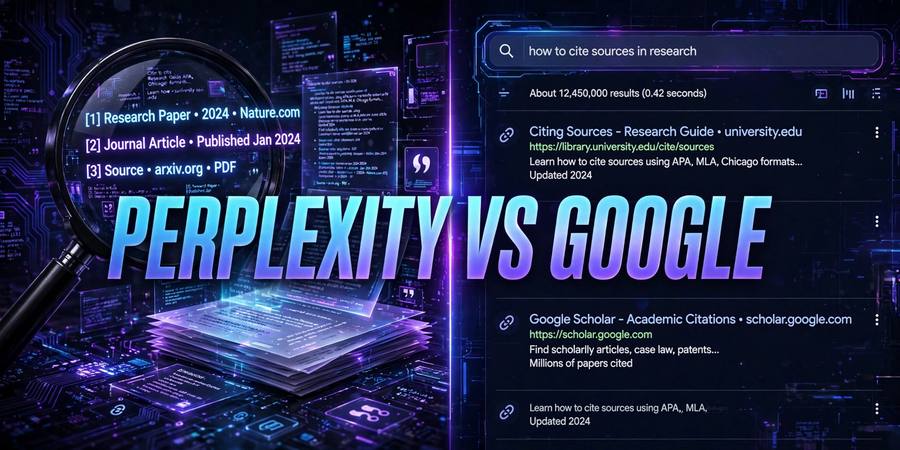
Perplexity vs Google: Which Answers Better? (2026)
For 25 years, “just Google it” was the answer to every question. In 2026, there is a real challenger: Perplexity AI, a search engine that reads the web for you and answers in plain language — with sources attached. I ran both side by side this week. Here is where each one wins.
What Perplexity actually does differently
Google gives you ten blue links and wishes you luck. Perplexity searches live sources, reads them, and writes you a direct answer with numbered citations you can click to verify. Ask who won a recent final and what the score was and you get one paragraph with the answer — not a page of results to dig through.
Under the hood, it is a large language model wired to a live search index. That combination — current information plus readable synthesis — is what makes it feel like asking a well-read friend instead of querying a database.
The side-by-side test
I ran the same five questions through both:
Factual questions with a clear answer (sports scores, release dates, statistics): Perplexity won on speed and clarity every time. One answer, cited, done. Google got there too, but it took scrolling past ads and SEO filler.
“Why” and “how” questions (explain a concept, compare two options): Perplexity won again — a structured explanation beats ten tabs. Though I still opened one or two citations to double-check anything important, which is a good habit with any AI.
Shopping and local queries (best laptop under $800, pizza near me): Google won easily. Maps, reviews, prices, and local business data are areas where Google’s two-decade head start still shows.
Breaking news from the last few hours: roughly a tie, with a slight edge to Google’s fresher index on very recent events.
Where each one wins
Use Perplexity when: you want a fast, readable answer to a factual or explanatory question — research, homework, settling debates, learning something new.
Use Google when: you’re shopping, looking for local businesses, navigating maps, or hunting for a specific website or video.
Most people in 2026 will end up using both, the same way we use both a microwave and an oven. Different tools, different jobs.
One honest caveat
Perplexity’s answers are only as good as the sources it reads, and AI can still misread or overconfidently state something wrong. The citations are the killer feature — use them. If a claim matters (health, money, legal), verify it at the source, whichever engine you used.
Who should try Perplexity
- Students and researchers: cited answers in seconds, with sources ready for bibliographies.
- Curious minds: “why is the sky blue”-type questions get genuinely good explanations.
- Professionals: quick factual checks without falling into a 20-minute browsing hole.
The bottom line
Perplexity did not kill Google, but it carved out the territory Google neglected: giving you the answer instead of the homework. For quick factual questions, it is now my first stop — and Google remains unbeatable for shopping and local. Try the same question in both and see which answer you trust more.
Related reading: Free AI Tools That Fix Blurry Photos in Seconds and How to Clone Your Voice with ElevenLabs AI
FAQ
Is Perplexity free? Yes, with a generous free tier. A Pro plan exists for heavier users and access to more powerful AI models.
Is Perplexity more accurate than Google? It is faster at delivering direct answers, but accuracy depends on sources — always check citations for important claims.
Will Perplexity replace Google? Unlikely in full. Google dominates shopping, local, maps, and video (YouTube). Perplexity wins the “just answer me” category.